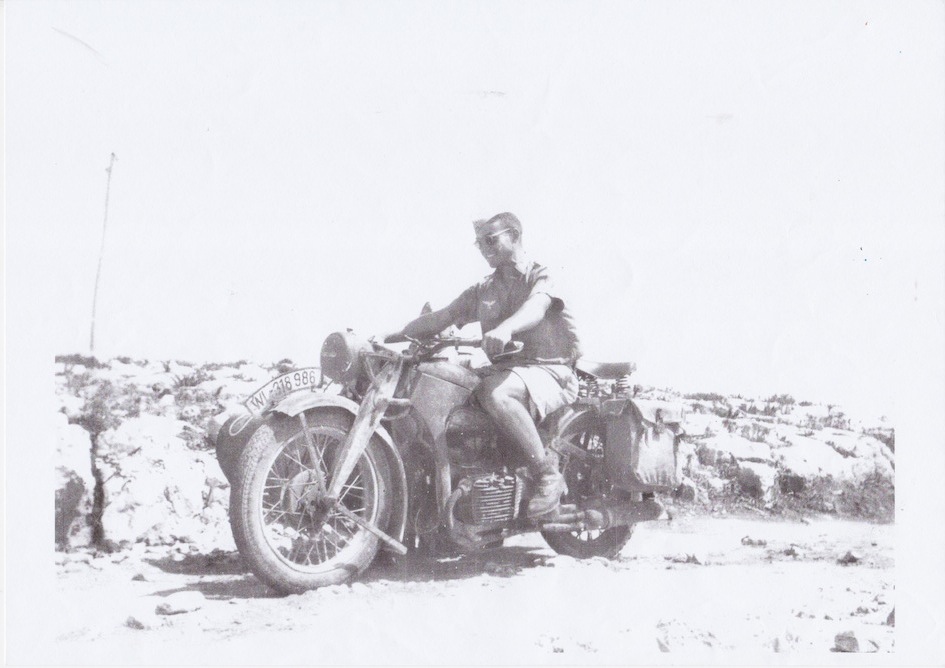
With this German Wehrmacht motorcycle — a BMW R75 with sidecar — the soldiers travelled back and forth between the harbour and the Albero Sole, where the radar station was operated.
The location of the islands Lampedusa, Pantelleria, and Malta.
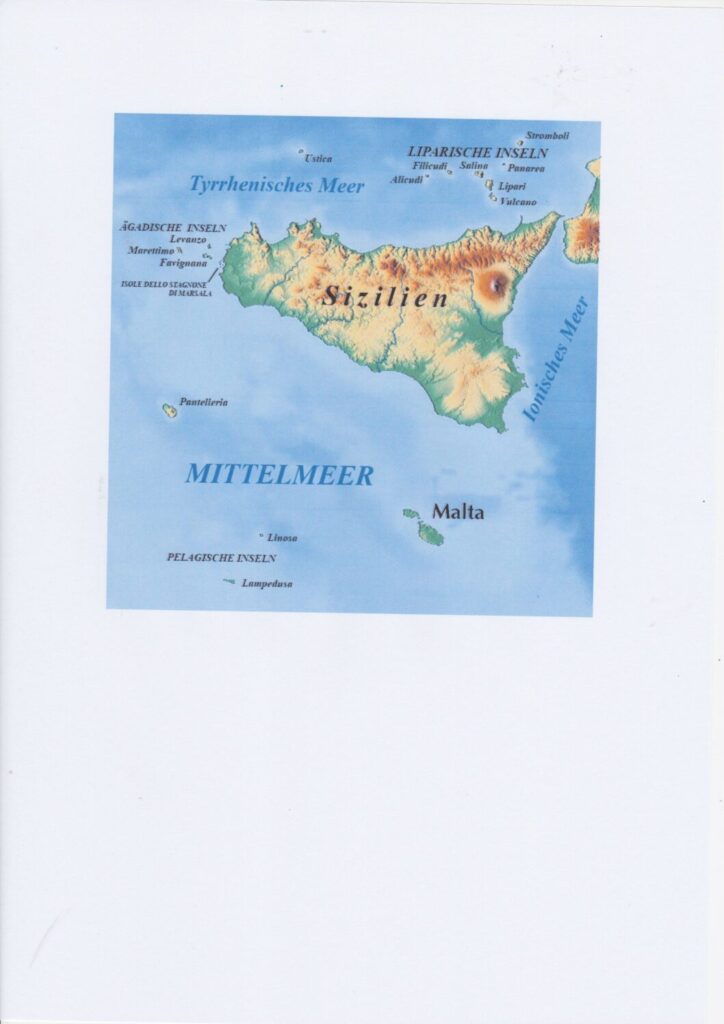
The Pelagic Islands, Pantelleria and Malta. Lampedusa is the largest of the Pelagic Islands in the Mediterranean, located between Sicily and Tunisia. It lies 138 km east of the Tunisian coast and 205 km south of Sicily.
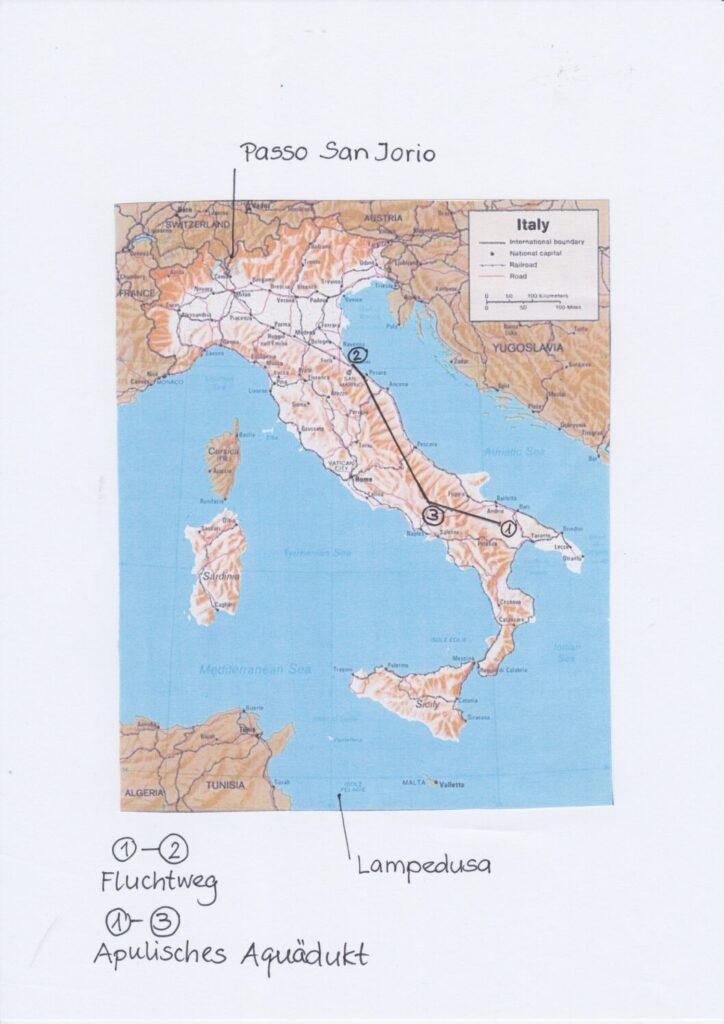
The escape route from Bari along the Apulian aqueduct and the coast up to Rimini.
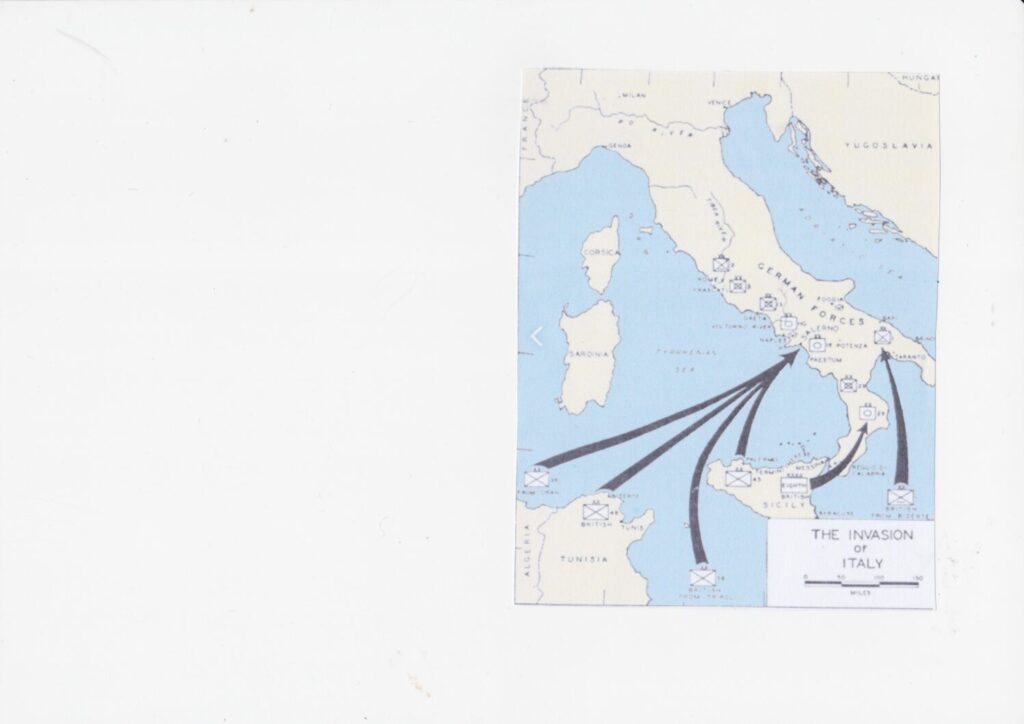
An espionage coup involving a corpse prepared the way for ‘Operation Husky’ (‘Operation Mincemeat’).
The attack on Sicily in July 1943 almost led to a rupture between the United States and Great Britain.
An espionage coup ultimately prepared the way for “Operation Husky.”
A victorious army deserves rest — but in moderation, and certainly not too much — for the self-confidence of soldiers who have defeated an enemy is as great as it is unstable.
It was ultimately this argument that convinced U.S. General Staff planners almost 80 years ago to give their battle-hardened troops a new task as quickly as possible after the victory over the Axis powers in North Africa.
In fact, the goals of the two Western powers seemed incompatible. Prime Minister Winston Churchill argued for striking first at Mussolini’s Italy and only afterward at Hitler’s Germany. The Americans, on the other hand, favoured a direct blow against the Third Reich.
At the Casablanca Conference in January 1943, these opposing strategies led to fierce disputes. President Franklin D. Roosevelt barely managed to dissuade his General Staff from effectively dissolving the alliance. U.S. Army Chief of Staff George D. Marshall wanted to threaten his British counterparts that, if Britain insisted on its plan, the Americans would largely withdraw from the European theatre and focus their efforts on Japan in the Pacific.
Churchill’s generals countered that Hitler’s sphere of power would be better attacked from the periphery, tying down German troops in the south and west. They argued the Allies should first attack Sicily from North Africa, and then advance northward through the Italian mainland toward Central Europe.
In the end, Roosevelt and Churchill reached a compromise. After the victory in North Africa, the Americans and British would land in Sicily and capture the island. This would put pressure on the Wehrmacht, secure Allied sea routes through the Mediterranean, and possibly bring down the already faltering Mussolini regime. However, an automatic continuation of the attack onto the Italian mainland was not planned — that decision would depend on how the Sicilian landing went.
A major factor behind this decision was the desire to keep the battle-tested troops from the North African campaign engaged. They were granted a rest period of four to eight weeks before the next offensive would begin.
Since the strategic importance of Sicily was obvious — and could hardly escape the notice of the German Commander-in-Chief South, Field Marshal Albert Kesselring — the Allies took great pains to disguise their true intentions.
Through various channels, British intelligence leaked information suggesting there would first be diversionary attacks on Sicily and Greece, followed later by a main assault on Sardinia and Corsica. The stated goal of Allied troops was to liberate French territory as quickly as possible.
To reinforce this impression within German intelligence, the British secret service MI6 launched a daring operation: “Operation Mincemeat.”
A corpse taken from a London morgue was dressed up as a British staff officer. A briefcase was chained to the body containing convincingly forged letters hinting at Sardinia and southern France as targets. A submarine then released the body off the coast of Catalonia.
At the same time, the British “accidentally” transmitted poorly encrypted radio messages about the search for a missing courier in the Mediterranean. The body of the supposed Major William Martin eventually washed up on the Spanish coast and was handed over — with some delay — to the British military attaché. But the documents he carried had already been photographed by the pro-German authorities and passed to the German attaché. The false trail was thus laid.
As a result, the German command believed that the capture of the Pelagic Islands and the larger island fortress of Pantelleria was merely a diversion. Pantelleria, which had been heavily fortified, was bombarded intensively beforehand. When the Allies landed there on June 11, 1943, the roughly 11,000 Italian and German troops were so surprised that they surrendered immediately.
The Western Allies then waited four weeks — not because the invasion forces of seven divisions (four British and three American) needed more preparation, but to accommodate the preferences of two military branches.
Airborne troops favoured moonlit nights to drop accurately over their landing zones, while naval units preferred total darkness to maintain surprise for as long as possible. On the night of July 9 to 10, 1943, both wishes coincided: the moon rose early in the evening and set again around midnight.
“Operation Husky”, the first major amphibious landing after the failed attempt at Dieppe, could begin.
A Malariologist’s Knowledge Becomes Hitler’s Weapon
In May 1939, only a few months before the outbreak of the Second World War, Germany and Italy signed a pact of military and political alliance — the Pact of Steel. The name itself suggested something unbreakable. Yet in 1943, Italy agreed to an armistice with the Allies, effectively turning against Germany.
With the downfall of Benito Mussolini, Hitler was on the verge of losing Italy. After the Allied invasion of Sicily and Mussolini’s subsequent arrest and removal from power, the Pact of Steel was finally broken. A new relationship emerged between the Allies and the Italian government.
The new government under General Pietro Badoglio declared itself on the side of the Allies, thus becoming an enemy of Nazi Germany. In response, Hitler sanctioned the military occupation of Italian regions. The German Wehrmacht, already present throughout Italy, took advantage of the disorder within the Italian armed forces to seize strongholds across the country. Brutal measures followed — civilians were forced to work for the occupiers, and resources were plundered.
However, the most infamous act of the Third Reich in retaliation for Italy’s “betrayal” was initiated by Erich Martini. Martini, a friend of the feared Heinrich Himmler — the architect of the Holocaust — was Europe’s leading malariologist. His expertise became one of Hitler’s weapons in an attempt to trigger a malaria epidemic in Italy.
Although the Germans had lost the Battle of Sicily, they managed to hold the Gustav Line south of the Pontine Marshes, forcing the Allies to land at Anzio and Nettuno. The Pontine Marshes lay about forty kilometres south of Rome. During Mussolini’s time as Prime Minister, these marshes had been drained and reclaimed. In less than ten years, 840 square kilometres of land were made arable, and forty-three farm settlements were established. Other swamp areas in Italy were also reclaimed.
In 1943, however, under Martini’s direction, the Pontine Marshes were deliberately reflooded. Over a million larvae of the Anopheles labranchiae mosquito — the carrier of malaria — were released into the water. Seawater was also allowed to flow into the area. The resulting increase in salinity made the environment unsuitable for most plants and animals but ideal for the explosive growth of mosquitoes.
The flooding of the Pontine Marshes — and with it the deliberate spread of malaria — aimed to slow down the Allied advance. The Nazis even destroyed the pumps in the Tiber Delta, not as an act of simple sabotage, but as a form of biological warfare. The German forces understood that flooding the delta would multiply the risk of malaria infection among their enemies.
Half a metre of standing water on Rome’s coastal plains not only impeded the movement of troops and vehicles but also recreated the perfect breeding conditions for the mosquitoes responsible for transmitting malaria. The German command ordered all drainage pumps in the Maccarese area of the northern Tiber Delta to be shut down. Within two weeks, most of the other drainage pumps in the delta were also stopped. In some cases, the pumps were even reversed — instead of draining the land, they pumped water back into it. Drainage canals were blocked to cause greater flooding.
Just a few months after the invasion of Sicily, 21,000 British and American soldiers had already contracted malaria. The spread of the disease led to an epidemic that also had devastating consequences for the civilian population.
A white line divided two worlds
In October 1943, the German Reich declared war on Italy. This led to around 50,000 prisoners of war being released from Italian camps — only to find themselves now hunted by the Germans. Thousands fled to Rome, seeking refuge, help, and hiding places alongside others opposed to the Nazis.
Word spread that every evening, on the steps in front of St. Peter’s Basilica, a tall monsignor stood — O’Flaherty was over 1.90 metres tall, athletic, and a former boxer — and that Allied soldiers who had escaped from prisoner-of-war camps could find there a man willing to listen and to help, prayer book in hand. If they were lucky enough to make it to St. Peter’s, he would lead them to safety.
O’Flaherty’s most determined and dangerous opponent was Obersturmbannführer Herbert Kappler, commander of the German security police in Rome. Kappler had a white line painted across the pavement at the foot of St. Peter’s steps. That white line separated two worlds: the Republic of Italy and Vatican City — danger and safety, captivity and freedom, and sometimes even life and death.
On one side, German soldiers patrolled day and night; on the other, O’Flaherty stood on the steps of St. Peter’s. Kappler had the line painted to make one thing clear to the Irish priest:
If you step over this line, I’ll have you. Then you’re on my ground — and we’ll kill you.
Beyond that line, the Wehrmacht and Gestapo hunted Allied soldiers, prisoners of war, deserters, Jews, opposition members, and resistance fighters throughout occupied Italy. Kappler had set in motion a ruthless machinery — and Hugh O’Flaherty was the man who threw sand into its gears.
With a mix of courage and faith, the Irish priest used the small freedoms his position in the Church and the Vatican afforded him to find hiding places, food, and escape routes. Under the Pope’s very eyes, he engaged in a deadly game of cat and mouse with his German pursuers. Kappler and his men were constantly on his trail. Their relentless chase cut across the Eternal City — through palaces, church naves, and even coal cellars.
On one occasion, when O’Flaherty was visiting an aristocratic family that supported him in their Roman palazzo, the SS got wind of it and stormed the building. The priest fled into the basement, where he came across two workers delivering coal. Acting on instinct, he turned himself into a “coal man.” He grabbed one of the empty coal sacks, pulled off his cassock and stuffed it inside, then rubbed coal dust over his face, shirt, and long underwear.
As he followed the coalmen up out of the cellar, he froze — the SS were there, their submachine guns glinting in the sunlight. Unperturbed, the man in sooty underwear hoisted his sack over his shoulder and trudged past the SS, following the other coalmen — completely unchallenged. Had he not thought of the coal sack, he would have been arrested, tortured, and executed.
O’Flaherty built a wide network of helpers. When, on 16 October 1943, Berlin ordered the arrest and deportation of all Roman Jews, even more hiding places were needed. Many found refuge through O’Flaherty’s organisation in monasteries and on farms outside the city. The priest was constantly on the move, often leaving the Vatican at dawn and crossing the white line again and again — sometimes in daring disguises as a street sweeper, postman, labourer, or even a nun. (His helpers discouraged that last one — a 1.90-metre nun wasn’t terribly convincing.)
Hugh O’Flaherty acted on his own initiative — sometimes with quiet Vatican approval, sometimes against papal wishes. Kappler grew increasingly furious that he couldn’t catch the priest outside Vatican territory and devised a plan. He ordered two Gestapo officers to slip into St. Peter’s during Sunday Mass and drag the Irish priest across the white line. But the Swiss Guard noticed them, seized the Gestapo men, and escorted them out of the basilica.
On 4 June 1944, Rome was liberated by the Allies. Herbert Kappler managed to escape the city, but in May 1945 he surrendered to British military police in Bolzano and was sentenced to life imprisonment.
Only one visitor came to see him regularly in his cell: Hugh O’Flaherty. In 1959, Kappler was baptised by the very man who had once outwitted him and converted to Catholicism.
The priest was harshly criticised — especially by the press. How could he forgive Rome’s most feared enemy and visit him regularly in prison? O’Flaherty remained calm in the face of criticism, always replying with a single line:
God has no country.
It is that same sentence that stands today on Hugh O’Flaherty’s life-size bronze statue, unveiled in 2013 in his Irish hometown of Killarney to mark the 50th anniversary of his death.